Heading 1
Heading 2
Heading 3
Heading 4
Heading 5
Heading 6
Lorem ipsum dolor sit amet, consectetur adipiscing elit, sed do eiusmod tempor incididunt ut labore et dolore magna aliqua. Ut enim ad minim veniam, quis nostrud exercitation ullamco laboris nisi ut aliquip ex ea commodo consequat. Duis aute irure dolor in reprehenderit in voluptate velit esse cillum dolore eu fugiat nulla pariatur.
Block quote
Ordered list
- Item 1
- Item 2
- Item 3
Unordered list
- Item A
- Item B
- Item C
Bold text
Emphasis
Superscript
Subscript
More data has never guaranteed better AI. This month made that clearer than ever. Across Smart Manufacturing, Earth Observation, and Healthcare AI conversations, the same constraint kept surfacing. Not a shortage of data, but a shortage of data that is structured, validated and ready to act on. The gap between what organisations collect and what their AI can actually use is where most ambitions quietly stall. This edition focuses on what sits inside it and why it is becoming the defining constraint for AI in high-stakes industries.
Manufacturing Competitiveness Has Shifted: Most Factories Have Not Caught Up
The structural gap now defining smart manufacturing performance.

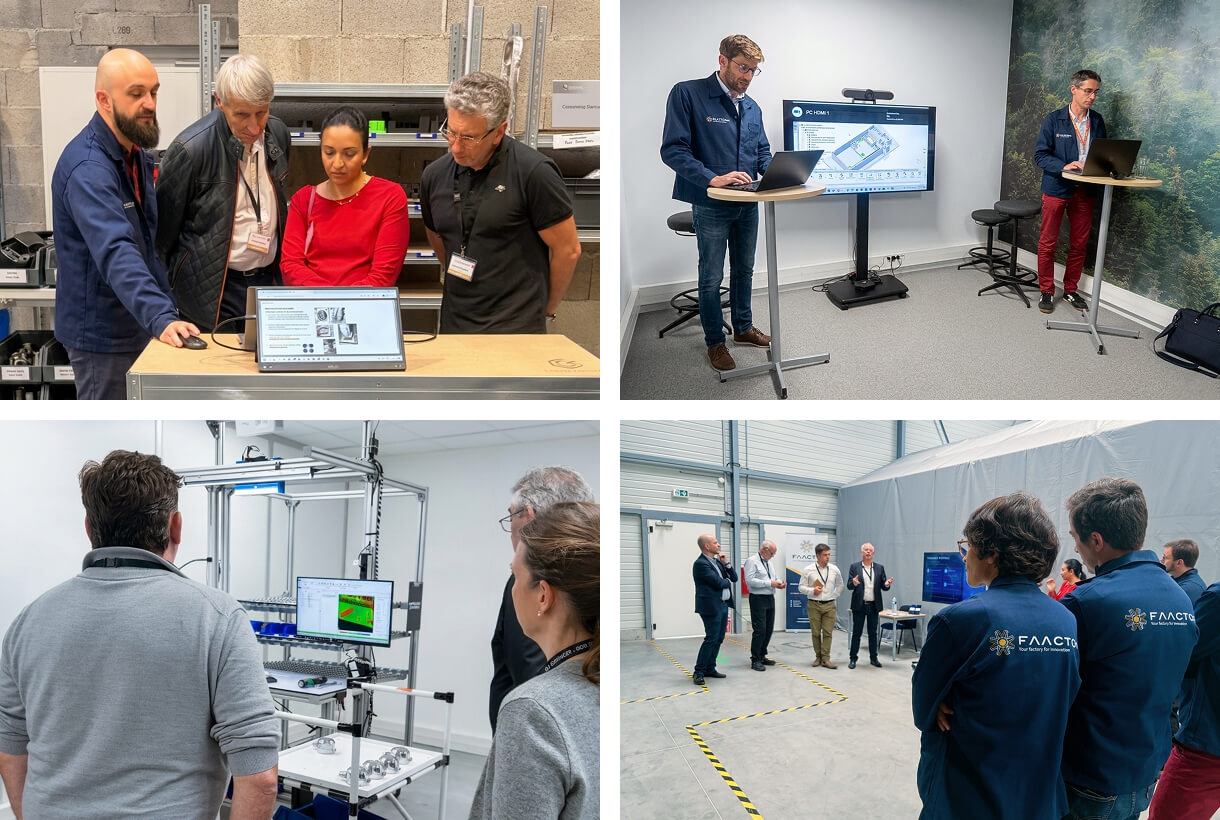
The factories gaining ground today are not the largest or the most automated. They are the ones that reconfigure fastest. That speed depends entirely on the quality of the data layer underneath operations. This was the clearest signal from the Systematic Paris-Region factory tour at Faactopi's premises in Lyon, France. Most industrial sites collect data. Very few have workflows structured enough to support real-time AI decisions. Competitive agility is now a data infrastructure problem, not a capital investment problem. The manufacturers pulling ahead are making their existing information actionable, not collecting more of it. If your AI ambitions are outpacing your data workflows, that gap is worth examining.
Explore Industrial Data Workflows
Satellite Data Is Scaling Faster Than the Systems Built to Interpret It
The constraint that enterprise Earth Observation cannot automate its way out of.


Satellite constellations in Low-Earth Orbit (LEO) are generating Earth Observation (EO) data at volumes that outpace most organisations' ability to process reliably. This was among the sharpest signals at ATxEnterprise 2026 in Singapore, where AI, next-generation telecom and satellite infrastructure converged. Data collection has scaled, but validated interpretation has not. High stakes classification still requires human judgment at critical points. The highest-performing Earth Observation systems are not fully automated. They are designed around knowing precisely where human expertise must remain in the loop.
Organisations pulling ahead are investing in validation at every stage. That distinction is becoming a structural competitive divide. If your team is managing satellite data at scale, the question worth asking is where human judgment is still compensating for what your pipeline cannot do.
Discover Our Earth Observation Capabilities
In Clinical AI, the Data Standard Has Always Been Absolute
The compliance reality shaping oncology AI pipelines.

Regulatory alignment in oncology does not sit at the end of a process. It shapes every annotation decision and design choice from the beginning, not as an addition, but as a foundation. As oncology AI moves closer to clinical deployment, the gap between model performance and real world readiness is defined by data infrastructure. Data quality is not a metric. It is a patient safety requirement. IngeData achieves up to 97 percent precision in lung cancer annotation workflows, delivered within ISO 9001 and ISO/IEC 27001:2022 certified frameworks aligned with FDA Quality Management System Regulation (QMSR) requirements.
Tony Thomas, Chief Commercial Officer for Healthcare, will be in Chicago during the ASCO Annual Meeting from May 29 to June 2 for focused discussions on annotation accuracy and compliance-ready pipeline design. Connect with Tony Thomas to discuss your oncology data pipeline.
The standard has not changed. The pressure to ignore it has. Across every high-stakes industry, the organisations struggling with AI performance share one pattern. They treat data preparation as a later problem. The ones delivering results treat it as the first. In the industries we serve, unreliable data is not measured in accuracy points. It is measured in outcomes. IngeData's ISO 9001 and ISO/IEC 27001:2022 certified workflows exist because the cost of that discovery is too high to leave to chance.
If any of the themes in this edition connect with challenges your organisation is facing, we welcome a focused conversation with you.