Heading 1
Heading 2
Heading 3
Heading 4
Heading 5
Heading 6
Lorem ipsum dolor sit amet, consectetur adipiscing elit, sed do eiusmod tempor incididunt ut labore et dolore magna aliqua. Ut enim ad minim veniam, quis nostrud exercitation ullamco laboris nisi ut aliquip ex ea commodo consequat. Duis aute irure dolor in reprehenderit in voluptate velit esse cillum dolore eu fugiat nulla pariatur.
Block quote
Ordered list
- Item 1
- Item 2
- Item 3
Unordered list
- Item A
- Item B
- Item C
Bold text
Emphasis
Superscript
Subscript
Why the data behind an AI system matters more than what gets shown on the surface
A certified device is not the same as a trustworthy one. A benchmark score is not the same as clinical proof. A budget commitment is not the same as an operational result.
Two annotators can look at the same medical scan and draw different boundaries around the same lesion. That disagreement, not the model built around it, often decides whether an AI system can be trusted in a real diagnosis.
This same gap surfaced twice more in September, dressed differently each time: on a certified device's spec sheet at a healthcare trade show in Singapore, and in a budget line moving from pilot to delivery across two industrial AI events in France. A certification, a benchmark or a budget tells you what was tested. None of them tell you whether it holds up outside those conditions.
Here's what that gap looked like across healthcare, research and industrial AI this month, and why it matters for anyone judging AI by what gets shown.
A Certified Device Is Not the Same as a Trustworthy One
Why a certification is not proof the data behind it holds up
A device can pass every certification and still leave the question that matters most unanswered: how was the data behind it built?
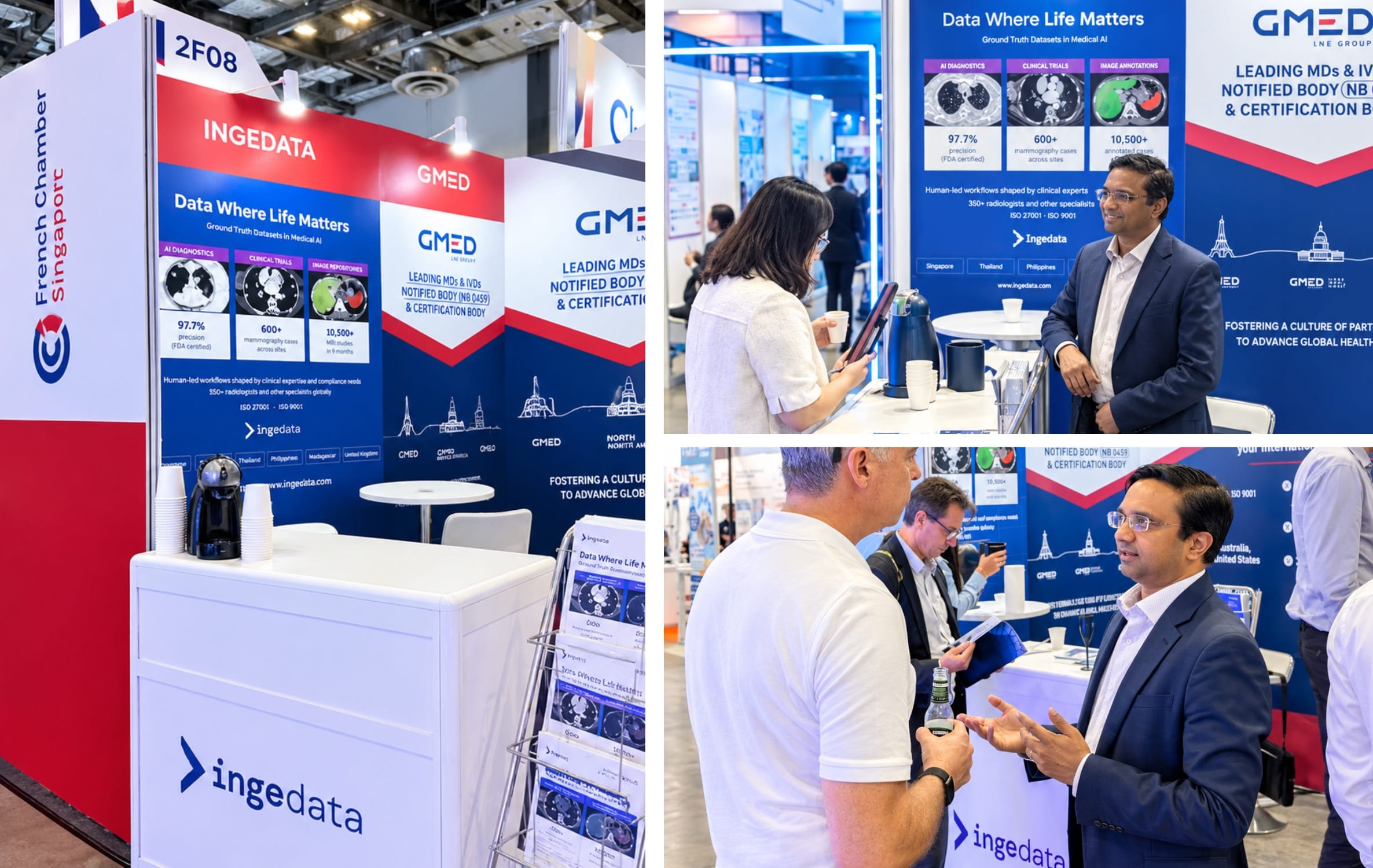
That question applies well beyond healthcare, but it was hardest to ignore at Medical Fair Asia, held from 9 to 11 September at Marina Bay Sands in Singapore, where most of the AI on display had already moved from prototype to certified product, built for a real clinical workflow. What a demo booth cannot show is the training behind it, the annotation, the review, and the consistency across thousands of cases that decides whether that AI can be trusted with a real scan.
Tony Thomas, Chief Commercial Officer for Healthcare, saw that gap firsthand representing IngeData at the event, as part of the French Pavilion organised by the French Chamber of Commerce in Singapore. It is the same gap IngeData's own results are built to close: lung cancer detection work reaching 97.7% precision across all stages and 96.8% recall for Stage I detection, and a breast cancer segmentation collaboration with University Hospital Basel that has helped models distinguish malignant tumours from benign findings with confidence, built on consistent, high quality annotation protocols across different breast densities and imaging conditions.
The Real Ceiling on AI Accuracy Isn't the Model
Why two annotators disagreeing on the same lesion matters more than architecture choices
Any AI system built on human-labelled data runs into the same limit eventually: the model can only be as consistent as the people who trained it.
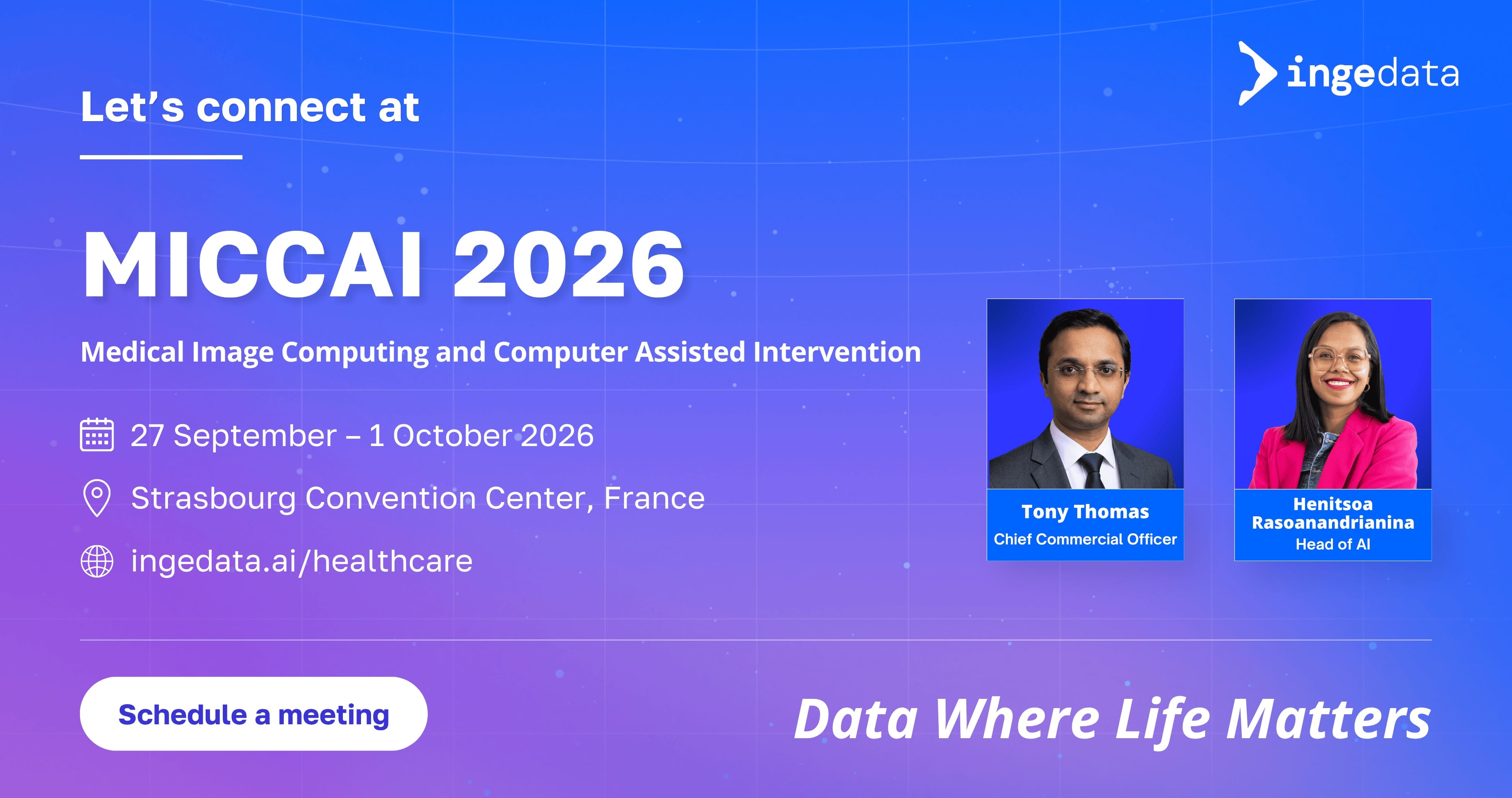
In medical imaging, that limit shows up clearly at MICCAI, one of the field's leading segmentation and medical imaging conferences, where discussions on accuracy tend to focus on the model. Less discussed is what happens when two annotators outline the same lesion differently. That inconsistency in the training data sets a hard ceiling on how reliable a model can be once it reaches clinical practice, regardless of how well the architecture performs on a benchmark.
This is the layer IngeData's Healthcare team works in: inter-annotator agreement, boundary-consistent segmentation, and QA calibrated for datasets that need to hold up under clinical and regulatory scrutiny and not just benchmark scores. Tony Thomas, CCO for Healthcare and Henitsoa Rasoanandrianina, Head of AI, are in Strasbourg for MICCAI 2026 until 1 October.
An AI Budget Shift Doesn't Answer the Harder Question
Why a bigger AI budget doesn't prove a system is ready
A bigger AI budget answers one question and raises another. Once funding moves from pilot to delivery, the harder question is whether the system can perform outside the conditions it was built and tested in. That question surfaced across two very different events this September. Farah Abbes, Industry Solutions Lead for Europe, attended both:
- Enterprise leaders weighing governance and scale at Big Data & AI Paris
- Industrial teams asking whether a vision system built and validated in a lab would hold up against the lighting, speed and variability of an actual production line at SIDO Lyon.
In both rooms, the gap was rarely the model or the sensor. It was whether the data used to build and test the system reflected the real conditions it now had to operate in, not the controlled conditions it was trained on.
That is the layer IngeData's Industry 5.0 team works in. We do not choose the model or the sensor. We make sure the data behind it holds up: annotating, reviewing and quality-controlling every detail so the dataset is consistent enough to train whatever system our clients bring to it.
Whichever model or sensor you deploy, the data has to come first.
Explore Industrial Data Readiness

What This Means Going Forward
A demo booth, a research conference, a boardroom and a production line made the same point this month: that devices, models or budget lines can only tell you so much. The questions worth asking underneath each one are the same. How was the data behind it built, checked and made consistent? Does it reflect the conditions the system now has to work in?
IngeData's ISO 9001 and ISO/IEC 27001:2022 certified workflows are built to answer that question. If any of these themes are priorities for your organisation this year, we welcome a focused conversation.