Heading 1
Heading 2
Heading 3
Heading 4
Heading 5
Heading 6
Lorem ipsum dolor sit amet, consectetur adipiscing elit, sed do eiusmod tempor incididunt ut labore et dolore magna aliqua. Ut enim ad minim veniam, quis nostrud exercitation ullamco laboris nisi ut aliquip ex ea commodo consequat. Duis aute irure dolor in reprehenderit in voluptate velit esse cillum dolore eu fugiat nulla pariatur.
Block quote
Ordered list
- Item 1
- Item 2
- Item 3
Unordered list
- Item A
- Item B
- Item C
Bold text
Emphasis
Superscript
Subscript
Consistent Data Cannot Scale by Accident
A pilot can hide a great deal. With a small dataset, a handful of annotators and time to review every difficult case, quality tends to look like a given. The test comes later, when volume grows, more people and sites contribute, and the same rules have to hold across all of them.
That is where the quality of training data gets tested. The question stops being how much data exists and becomes whether the process behind it can keep producing consistent results.
This edition looks at that question in three settings: large-scale medical imaging, multi-site clinical trials and robot demonstration data. The settings differ. The design problem is the same.
More Data Is Not the Same as Better Data
What happens to quality when a dataset moves from pilot to production
As datasets grow, small inconsistencies can become bigger problems. Annotation rules may be interpreted differently from one person to the next. Difficult cases may be handled one way by one reviewer and another way by the next. Valuable feedback may never make its way back into the workflow. The result is a dataset that looks complete but may not be reliable enough for the task it has to support.
For IngeData, reliable ground truth is decided by how data is produced, and not only by how it is checked at the end. Clear protocols, domain expertise, structured quality assurance and continuous feedback help keep interpretation consistent as volumes rise.
The same principle applies across the verticals we work in. Radiologists preserve clinical meaning when annotating thousands of MRI studies. Geospatial specialists interpret SAR imagery where objects look very different from optical data. Industrial experts define corrosion boundaries against complex surface textures. Robotics teams decide how a manipulation task should be captured before a single demonstration is recorded.
In each case, the standard is not set by the volume of data alone. It is set by the judgement applied while that data is produced.
For a closer look at what production-ready training data requires, read Ground Truth Quality for Computer Vision: What Makes Training Data Production-Ready?

Multi-Site Clinical Trials Show What Designed-In Consistency Looks Like
How image quality control and expert reads support comparable assessments across sites
Oncology clinical trials offer a demanding version of the same problem. Images arrive from multiple sites, and the assessments made on them need to be comparable, however many readers and locations are involved.
At ESMO 2026 in Madrid, IngeData highlighted how image management and expert reads work together to support that. Upfront image quality control and metadata verification come first. Assessments using the Response Evaluation Criteria in Solid Tumors (RECIST) version 1.1 are then carried out by board-certified, GCP-trained radiologists. Peer review, inter-rater reliability checks and image standardisation add further checks on consistency across multi-site studies.
The lesson reaches beyond oncology. In this workflow, consistency is not left to a final review. It is built into each stage, from the first image check to the final assessment, and the same principle applies to any large annotation workflow.

Robot Learning Turns Data Collection Into a Production Operation
What it takes to move from a handful of demonstrations to thousands, and keep them usable
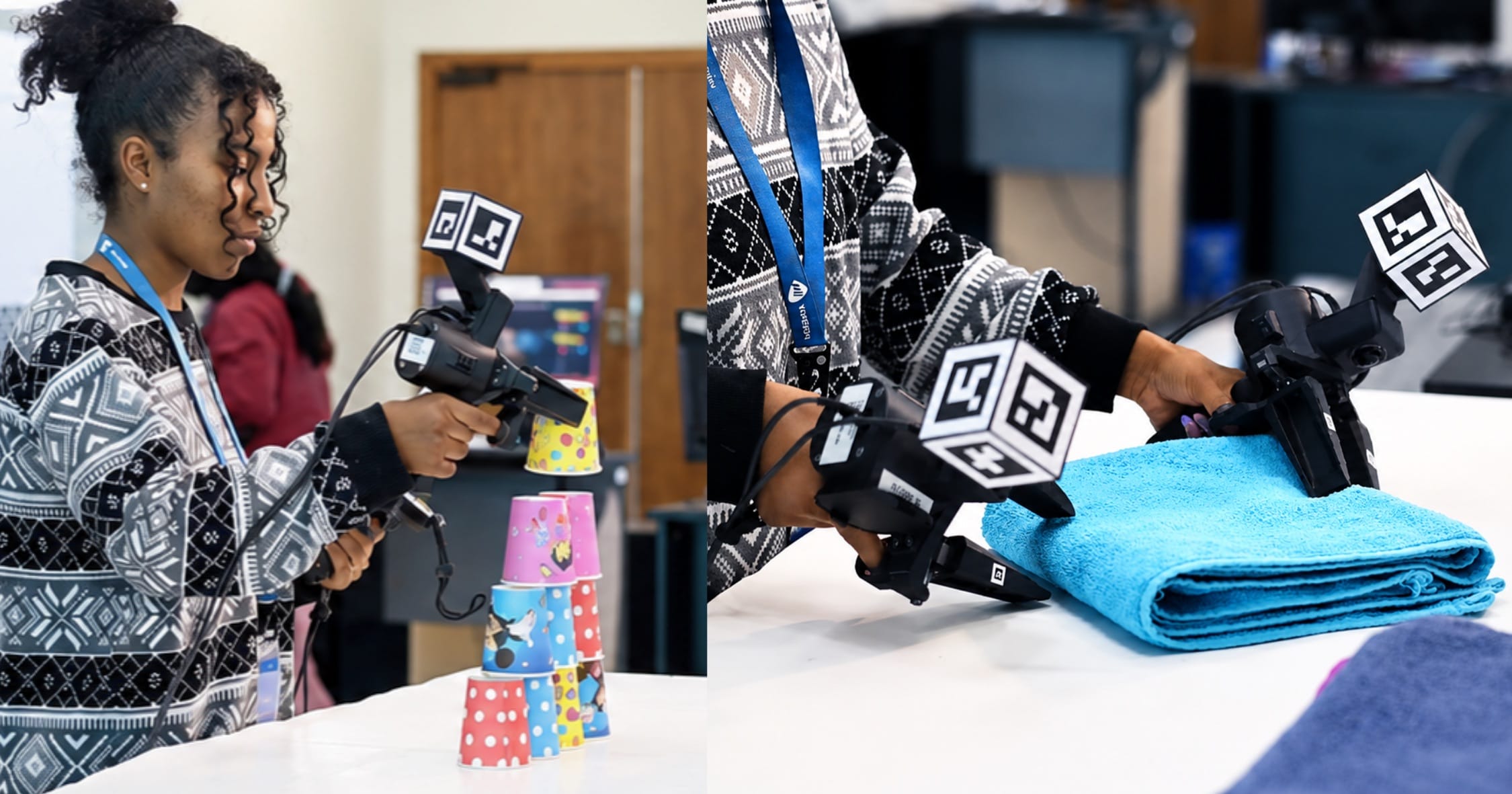
For robotics teams, the data problem looks different but follows a familiar pattern. Moving from a handful of successful examples to thousands of structured demonstrations takes trained operators, consistent capture setups and quality control.
IngeData is applying its AI data production experience to this physical setting, collecting and processing human demonstration data for robot manipulation models. Working with hardware partner Physical Data, the team configures capture environments around the task and the required volume, prepares operators to follow defined protocols and delivers structured episodes for the training pipeline.
The operation delivers 400 hours of usable production per day, with capacity to scale to 5,000 hours.
In IngeData’s approach, defined protocols and quality control at the point of capture are what keep demonstrations usable for training. A robot learns from what it is shown, so the reliability of the demonstrations is where reliable training begins.
Explore Robotics Data Production
What This Means for Your Data Workflow
Large imaging datasets, multi-site trials and robot demonstrations have little in common on the surface. In each, consistency at scale comes from how production is set up, not from a check at the end.
For IngeData, reliable AI starts with reliable data, and reliable data starts with how it is produced. Data quality does not settle how an AI system performs on its own, but it is where reliability starts.
For any team moving from pilot to production, a few questions are worth asking of its own data process. Who decides how a difficult case is handled, and how is that decision shared? How does reviewer feedback return to the guidelines? Will the process produce the same results when volume, sites or operators increase?
IngeData is ISO 9001 and ISO/IEC 27001:2022 certified, helping organisations establish trusted data processes for AI applications in regulated industries.
If these questions apply to a workflow your organisation is building or scaling, we welcome a focused conversation.